Coffee. That’s my entire weekday breakfast, and I’m a Korean guy in my forties living in Seoul with two kids.
Almost every English article about what Koreans eat for breakfast in Seoul shows you rice, soup, and a row of little side dishes. That table is real. In my apartment it happens about twice a year. My kids eat breakfast every single morning, I skip it, and the national numbers say my household is not unusual.
Do Koreans really eat rice and soup every morning?
Some do. Most mornings, in most homes I know, no.
Here’s the number I couldn’t find anywhere in the English results. In 2023, 34.6% of Koreans aged one and over had skipped breakfast on the day the national health survey asked about. In 2014 the same figure was 24.1%. That comes from the Korea Disease Control and Prevention Agency’s Public Health Weekly Report, published in January 2025 and based on the Korea National Health and Nutrition Examination Survey.
Read that carefully, because it’s easy to mangle. It says people skipped breakfast on one specific surveyed day. It does not say a third of the country never eats breakfast.
When Koreans do sit down to a traditional breakfast, though, the shape you’ve seen is accurate. There’s bap (밥), steamed short-grain white rice. There’s guk (국), a soup in its own bowl. And there’s banchan (반찬), the small shared side dishes.
One thing that trips up almost every visitor: guk is not a starter. It sits next to the rice, not before it, and you go back and forth between the two bowls for the whole meal. Nobody clears it away before the “main course” arrives. There is no main course.
Korean breakfast food is also just Korean food. There’s no separate breakfast category the way pancakes and cereal are breakfast-only in the US. Leftover stew at 7am is completely normal.
I assumed most people skipped it. The numbers said no.
If you’d asked me before I looked this up, I’d have told you flatly that more Koreans skip breakfast than eat it. Everyone around me skips. My whole adult picture of morning is a coffee cup.
I was wrong, and I’m leaving that in because the correction is more useful than my hunch. At 34.6%, skippers are a minority nationally.
Where my gut was right: people in their twenties. In 2023, 57.2% of Koreans aged 19 to 29 had skipped breakfast on the surveyed day, the highest of any age group.
The split that actually explains my apartment is the one between parents and their kids. In the 2022 national statistics, 41.9% of adults aged 30 to 49 skipped breakfast, against 14.2% of children aged 6 to 11.
So the grown-ups skip and the children eat. That gap sits at my kitchen table every weekday morning.
Why do people skip? A Korean government food agency published an analysis in January 2026 of social media posts from 2025, and reported that about a quarter of the opinions it gathered described skipping breakfast as a habit formed without any clear reason. That’s text analysis rather than a survey, so hold it loosely. But “no real reason, it’s just a habit” is my answer word for word.
Breakfast in my apartment, three different ways
Weekdays: coffee, and nothing else
Not “a quick something.” Coffee, and that’s the meal.
It’s not a time problem and it’s not that I dislike breakfast food. It’s habit, the same one the social media analysis picked up. I stopped at some point and never restarted.
The routine is always the same. I stir a cup of instant black coffee at home while I’m putting my shoes on, and I drink it in the car on the way to work. Nothing else goes in it and nothing else goes with it.
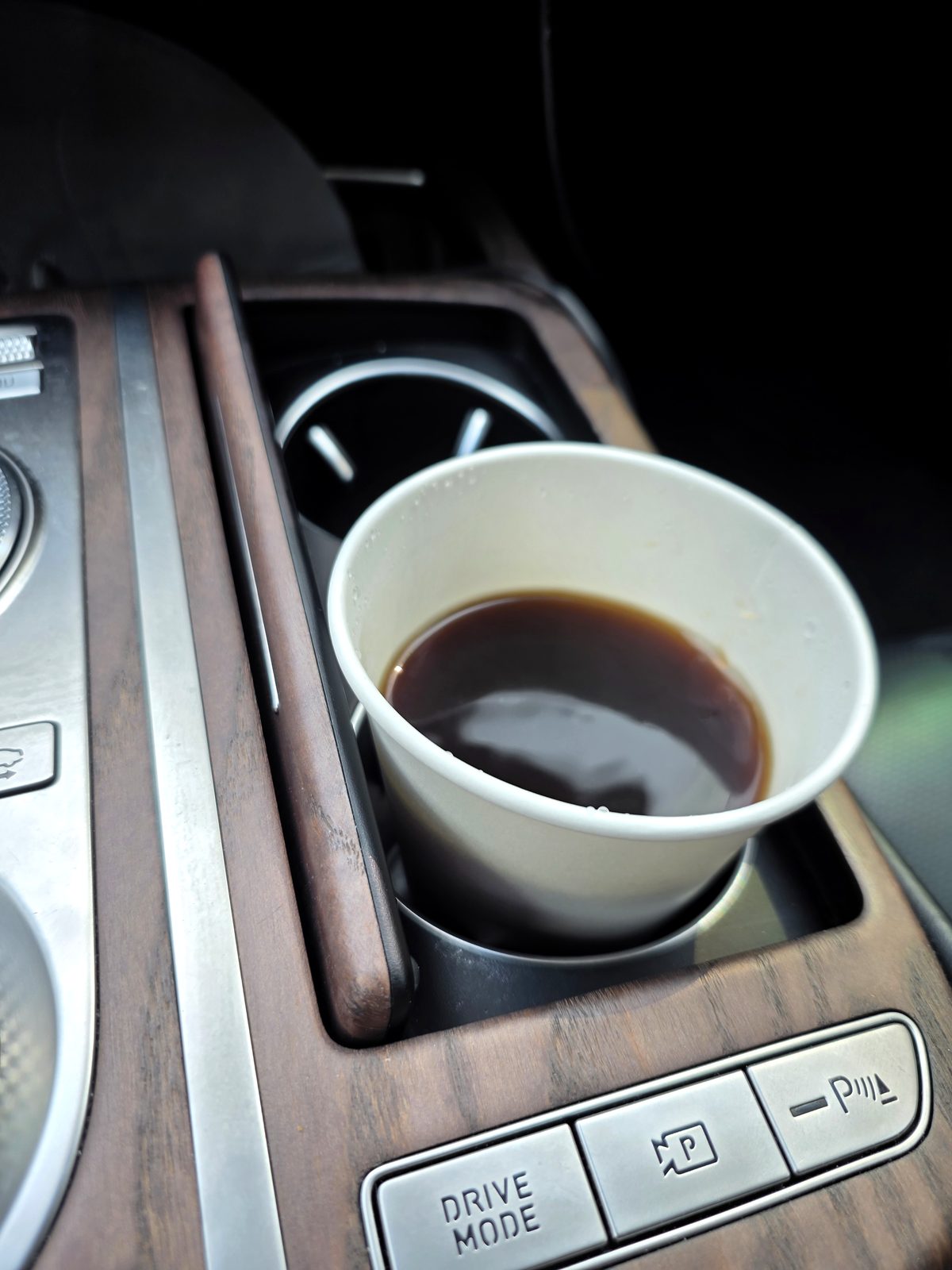
The second coffee is the one that matters here, though, because it’s the one you’ll see everywhere. After lunch, Korean office workers walk out and get a takeout coffee, and I do it too, from a shop near my office. Watch a Seoul street around 1pm on a weekday and you’ll spot the same cup in everybody’s hand: an iced americano. Koreans have shortened the name to “a-a” (아아), and it’s ordered that way year round, including in January. There’s a slang word for the people who do that: eoljuk-a (얼죽아). It’s a whole sentence crushed down to three syllables, and it means “iced americano even if I freeze to death.” Among Korean men in particular, that’s most of them.
I’m the odd one out. I drink mine hot and black, in August the same as in January, and the cup sitting in my car in that photo above was steaming.
A while back a French friend came to Korea and I drove out to the airport to pick him up. On the way out of the terminal he asked me, sounding a little worried about it, whether he’d be able to find a coffee shop in Seoul.
I laughed out loud.
I don’t have a number to prove this, so take it as one man’s opinion: I think Seoul has more coffee shops packed into it than anywhere else I’ve been. Finding one is not the problem. Choosing one is.
And don’t file that under Seoul only. Wherever you end up in this country, a small town, a beach, a bus terminal on the way to somewhere else, there will be a coffee shop, and probably three of them within sight of each other. If you’re coming to Korea and you care about coffee, that is the one thing you can stop worrying about.
The kids eat, and it isn’t rice and soup
My two grade-school kids are the opposite of me. They eat every morning.
The older one has bread, or jumeokbap (주먹밥), rice balls that literally translate to “fist rice.” The younger one has cereal. Neither of them touches rice and soup on a school morning, and I’ve never once seen them want to.
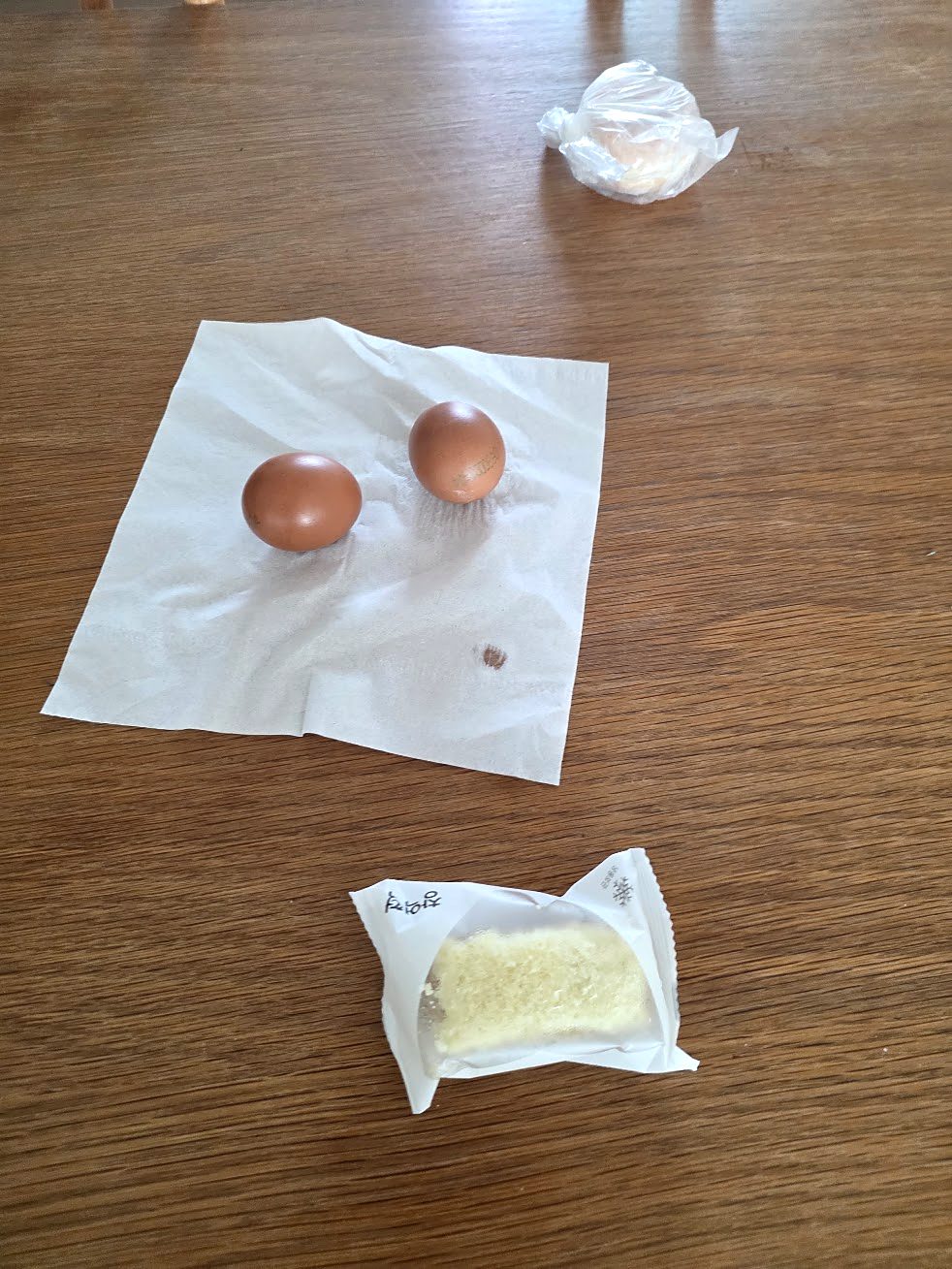
They’re on school holidays as I write this, which makes their breakfast even smaller. They get up late, so lunch is coming at noon anyway. This morning it was a boiled egg each, a doughnut for one of them and a piece of tteok (떡), Korean rice cake, for the other, and a glass of milk. That’s not a meal so much as something to stop the hunger until lunch.
Weekends: brunch with nothing Korean on the plate
My wife cooks, and she’s good at it, so weekends look completely different. We eat between 11am and noon, which makes it breakfast and lunch in one go. On a Saturday nobody in this apartment is eating anything at 7am.
Some weekends she makes open-faced shrimp and avocado toast. Other weekends it’s fried eggs with bacon and sausages, pan-fried potatoes, a salad, dinner rolls and black coffee. Go across that plate and try to find one Korean ingredient on it. There isn’t one.
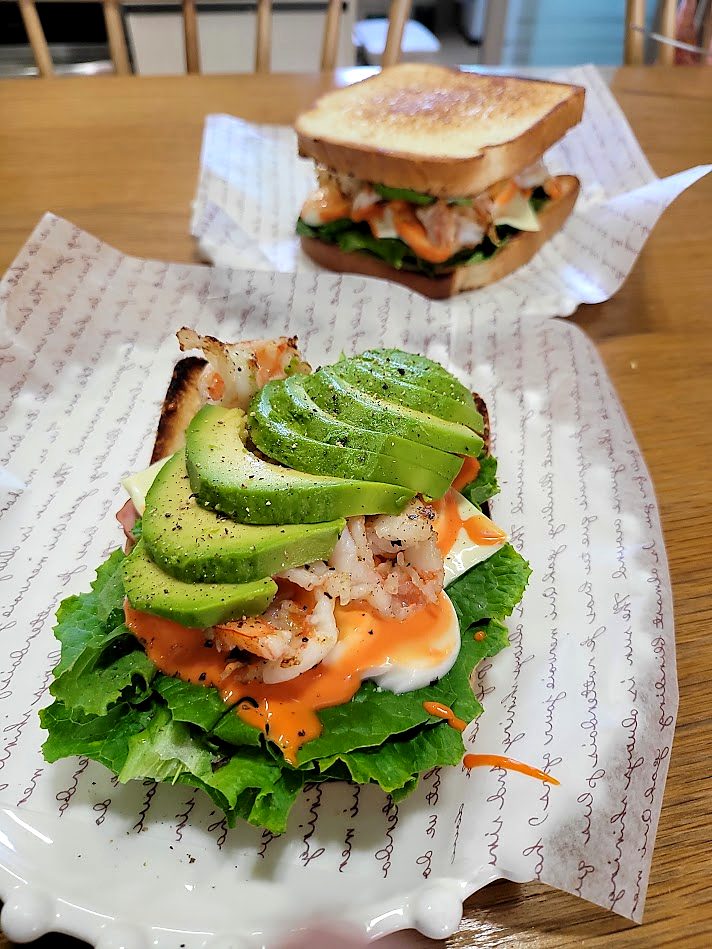
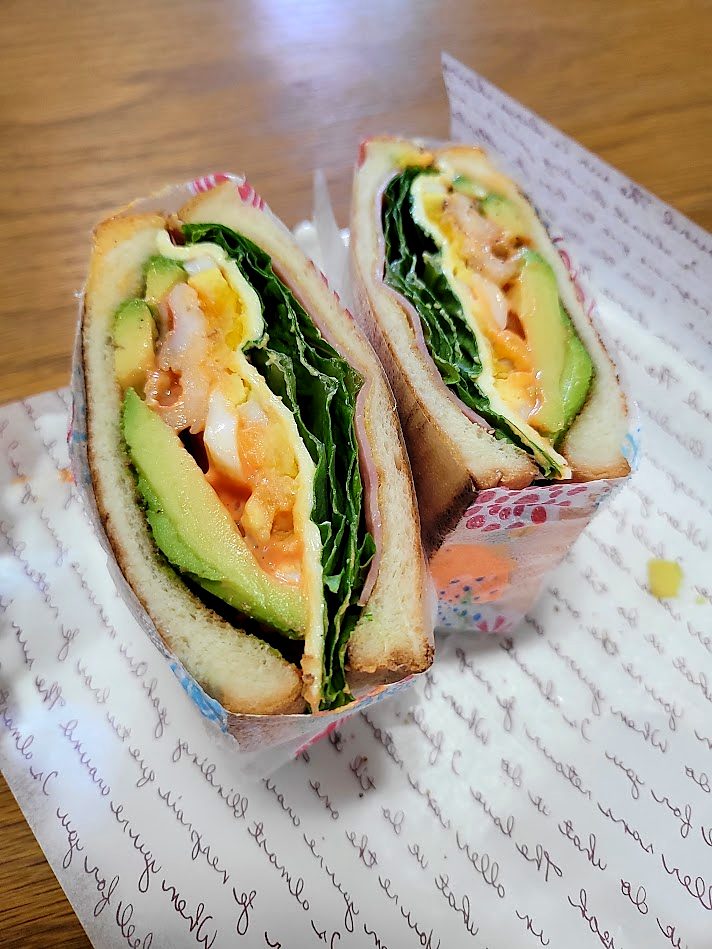
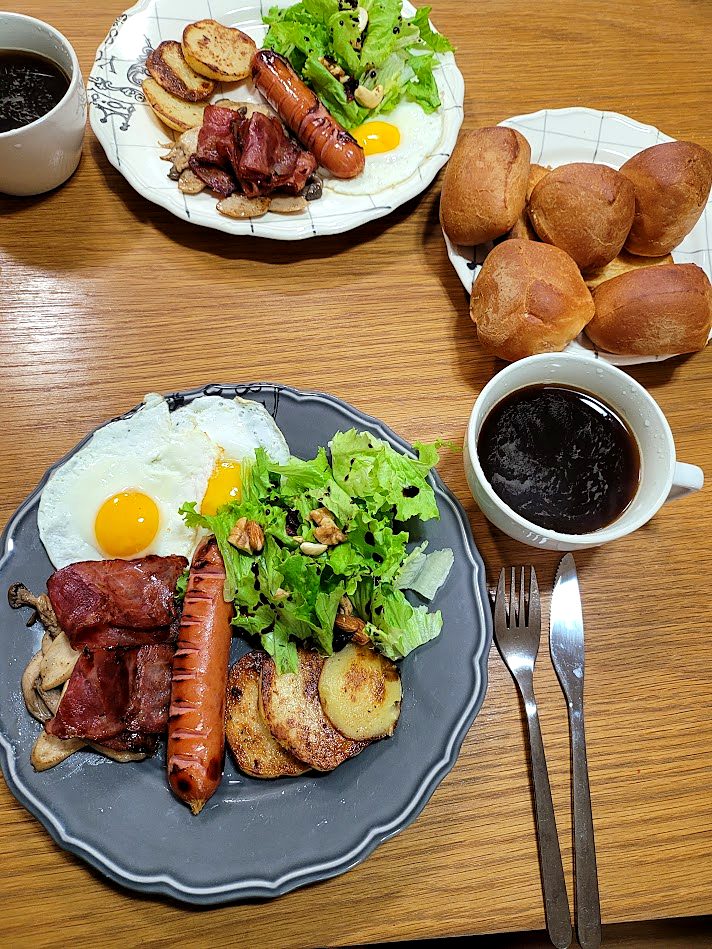
This is the part English-language articles almost never show you, and it covers more real Korean mornings than the rice-and-soup photo does.
The one morning the full table actually happens
Birthdays. That’s it, that’s the answer.
On a birthday morning in Korea you eat miyeokguk (미역국), a soup made from miyeok (미역), the soft brown seaweed sold in the US as wakame. Rice, seaweed soup, side dishes, first thing in the morning. Both photos below are from my apartment.
Two versions of the same soup
The first one is my wife’s birthday. I set that table, and I’ve done it every year since we got married.
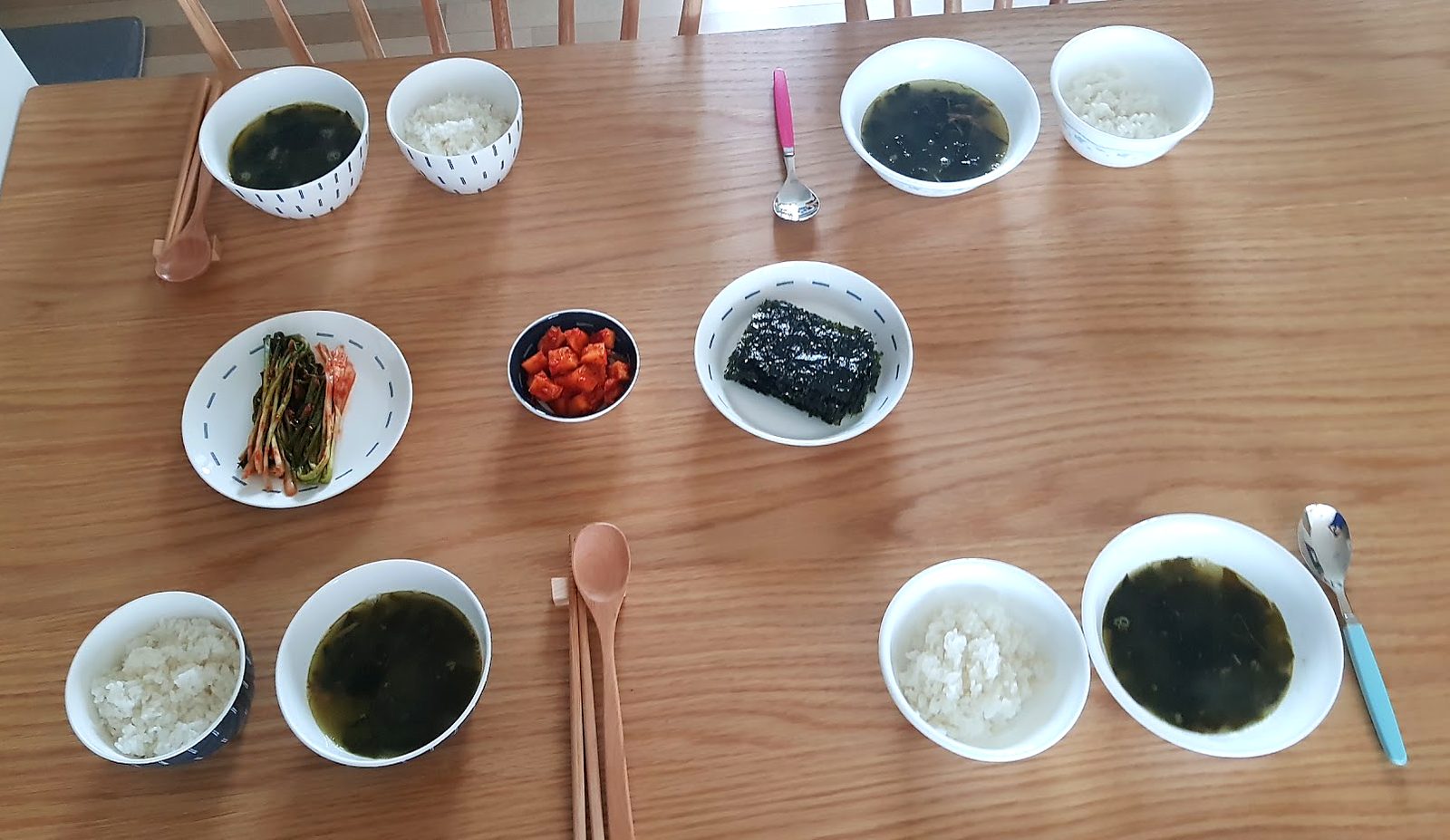
Everybody gets their own bowl of soup and their own bowl of rice, and then three things sit in the middle for the table to share. One is pa-kimchi (파김치), kimchi made from whole spring onions, which is sharper than the cabbage kind. One is kkakdugi (깍두기), cubed radish kimchi. The last is gim (김), sheets of seaweed that are roasted and then sprinkled with a little salt, so they’re crisp and light rather than salty.
Look at the spoons in that photo and you’ll notice they don’t match. Some are wood, some are steel. That’s because I didn’t set a guest table, I set our table, with the same dishes we use on an ordinary Tuesday.
The soup came out of a pouch. I buy CJ Bibigo’s instant beef and seaweed soup, pour it into a pot, and heat it for two to two and a half minutes. Five minutes if you microwave it instead, in a bowl, not in the bag. That’s the whole cooking process.
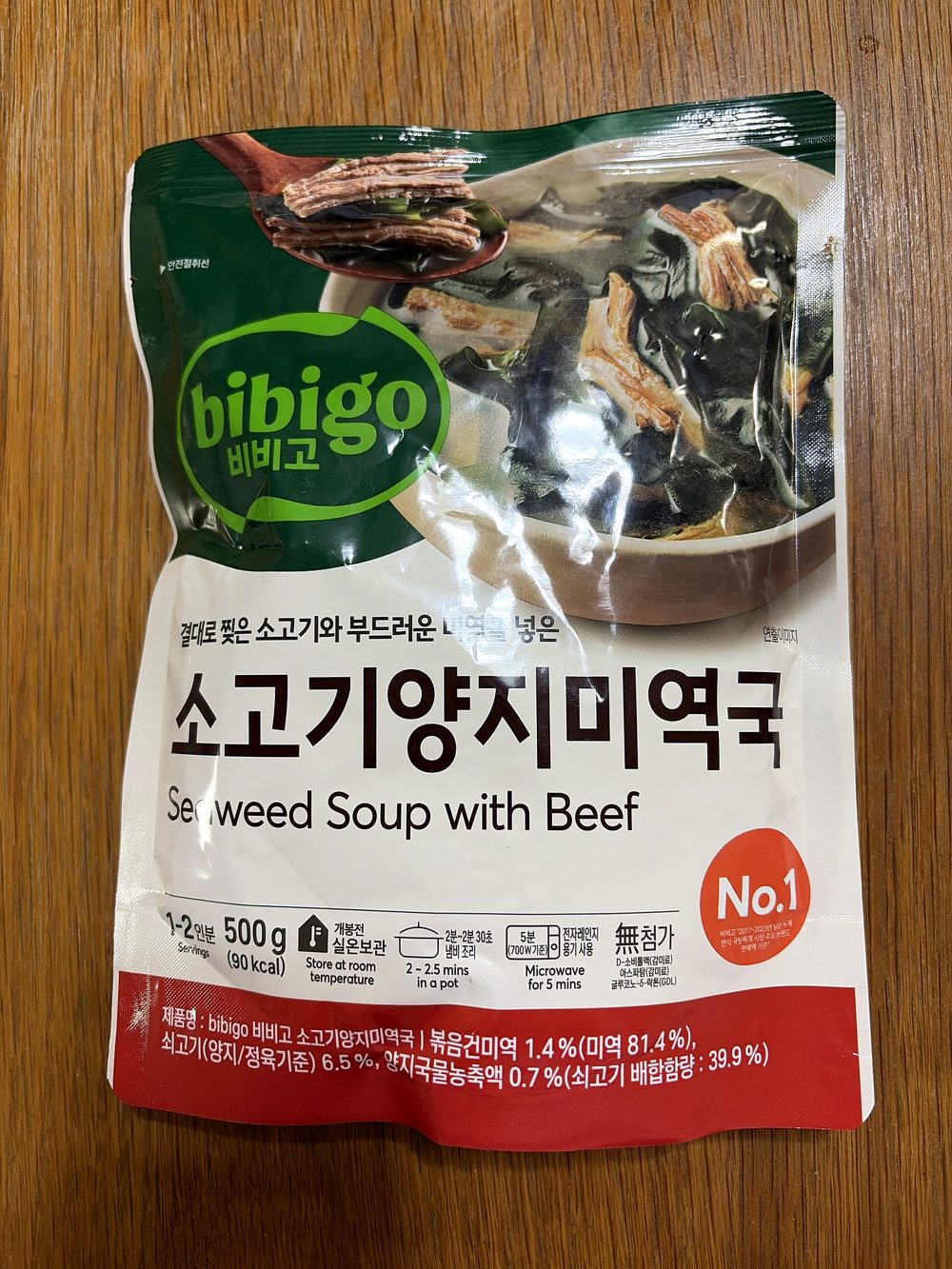
A 500g pouch costs me about 5,000 won, roughly $3.50 as of August 2026. I pick them up by the box at the supermarket on a weekend, or order them on Coupang, which is the Korean version of same-day Amazon. There are always four or five sitting in my kitchen, and not because of birthdays. My kids like it, so it’s normal food here.
Nobody is paying me for this and there’s no affiliate link anywhere in this post, so take it as one Korean’s honest opinion: of all the instant miyeokguk on the shelf, Bibigo’s is the best one. I’ve tried the others. I’ll admit it.
That’s the part I’d want you to take away. Every English article about Korean home cooking shows somebody simmering broth since dawn. In this apartment, on the day it matters most, a Korean man tears open a pouch he bought in bulk and heats it for two minutes.
The second photo is my birthday, and my wife made the soup from scratch with clam meat.
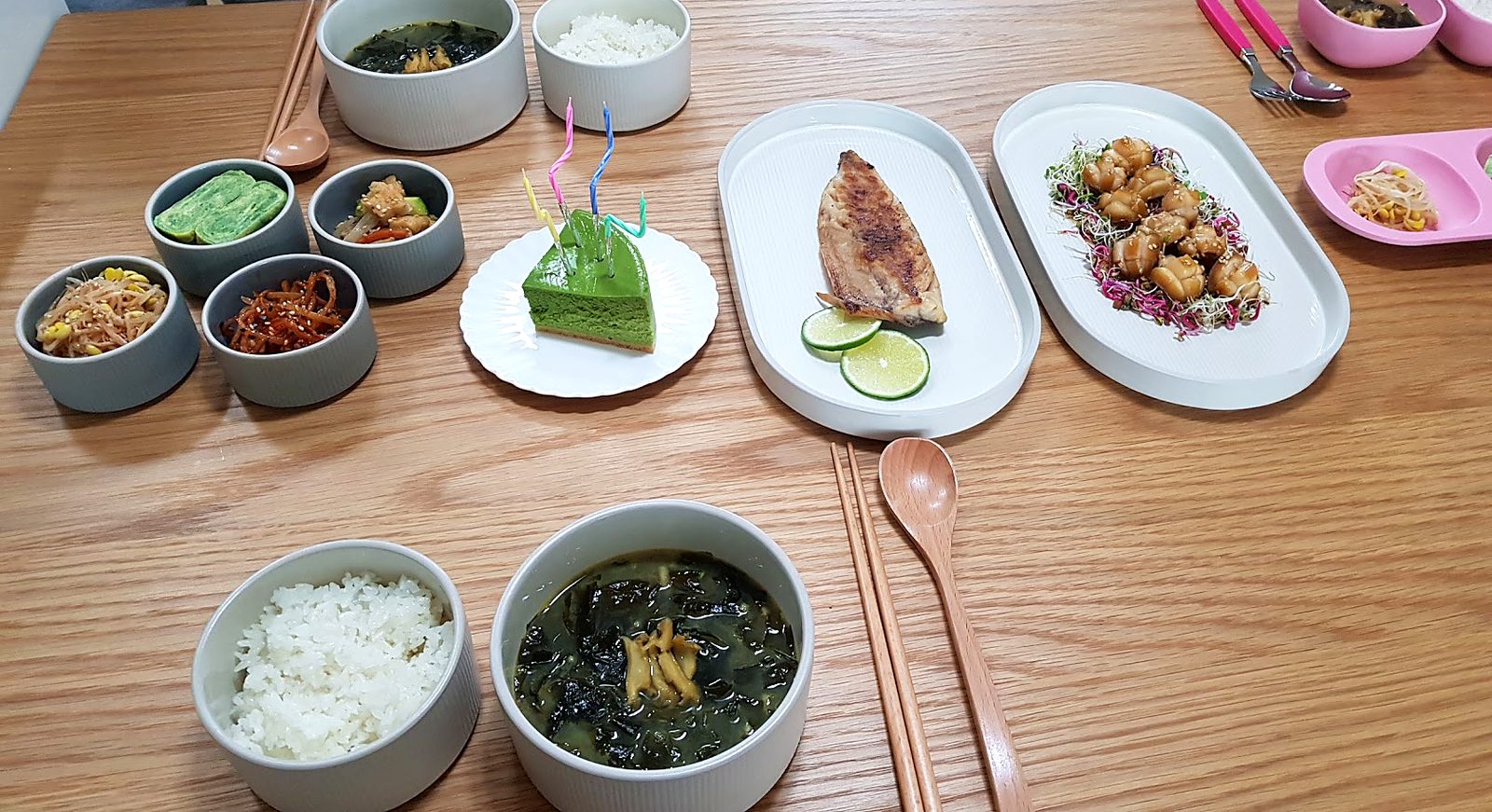
She put out more than six side dishes to my three: a rolled omelette with kkaennip (깻잎), perilla leaves, folded through it, seasoned soybean sprouts, shredded dried squid in gochujang (고추장), the fermented red chili paste that goes in half of everything here, and a whole grilled fish she cooked before I woke up. There was one more dish on that table that I still can’t name, in my own kitchen, on my own birthday. Her bowls matched, too, which mine hadn’t. And there was a cake with candles on it, at breakfast, because she decided that was happening as well.
Same soup, same meaning, same apartment. Two completely different tables.
Why it’s seaweed soup and not cake
The reason is genuinely nice, and it gets flattened in most English versions.
Miyeokguk is what a Korean woman eats right after giving birth. That first meal has its own name, cheot-gukbap (첫국밥): white rice and seaweed soup, nothing else. The National Institute of Korean History records that the rice was set aside in advance as special “birth rice,” that the soup was made with jangwak (장곽), long uncut strands of miyeok, because cutting them was thought to make the birth harder and shorten the baby’s life, and that no meat went in, since you avoid killing things right after a baby arrives.
The National Folk Museum adds the piece that explains the timing. That rice and soup were first offered to Samsin (삼신), the household deity of childbirth, and then given to the mother. The same offering was made on the morning of the baby’s 100th day and first birthday.
So the birthday soup isn’t really about you. It’s the soup your mother ate the week you were born, and you eat it once a year to remember that. My kids don’t know any of this. They just know that soup means somebody’s birthday.
One more thing, since you’ll see it repeated everywhere in English: the story that Koreans learned this from watching whales eat seaweed after giving birth. It’s a famous story in Korea too. But Korean-language sources point out that it spread into common knowledge largely through a newspaper column in 1986, and I haven’t been able to check the classical text it’s attributed to. Enjoy it as a story, not as history.
Never serve it to someone before an exam
Same soup, opposite meaning.
Miyeok is slippery, and in Korean, slipping is what you do when you fail a test. So here’s the rule, and Koreans keep it: you never serve miyeokguk to someone who has an important exam. Not the morning of it, not the night before. On the day of the national university entrance exam, some shops won’t sell it at all.
Practical version: if your Korean friend has a job interview tomorrow, don’t be clever and cook them birthday soup.
What’s open for breakfast in Seoul before 8am
This is where travel forums get people into trouble. Visitors land on a red-eye, drop their bags at 8:30am, walk out looking for a Korean breakfast, and find a street of locked doors.
Two words to know first. Haejangguk (해장국) means “hangover chaser soup,” and it’s the reason any Korean restaurant is open at 6am. Gimbap (김밥) is rice and fillings rolled in a seaweed sheet, sold by the roll, sliced into rounds and eaten with chopsticks.
| Time | What’s realistically open |
|---|---|
| 5-7am | 24-hour haejangguk shops, some market soup stalls, 24-hour gimbap chains, convenience stores |
| 7-8am | A few market gimbap shops, some ox-bone soup and set-meal restaurants, convenience stores |
| 8-9am | Older soup restaurants, franchise bakeries, many toast chains, coffee chains |
| 9am and later | Traditional markets on their official hours, cafes |
| 10-11am | Brunch cafes |
Two specific places I pulled hours and prices for, both checked in August 2026. I haven’t eaten at either one, so treat these as verified listings rather than my recommendations.
Imun Seolnongtang (이문설농탕) in Jongno is said to be the oldest continuously operating restaurant in Korea, dating to 1904, and it opens at 8am. It serves seolleongtang (설렁탕), milky ox-bone broth that’s simmered for 15 to 17 hours and arrives almost unsalted, because you season it yourself at the table. Address: 38-13 Ujeongguk-ro, Jongno-gu.
Tongtong Gimbap (통통김밥) in Namdaemun Market opens at 7am on weekdays, which makes it one of the genuinely early options. A basic roll is 4,000 won. It’s a 3-minute walk from Hoehyeon Station on Line 4, closed Sundays and on the second and fourth Saturday of the month.
| Item | Won | USD (approx.) | Source, checked Aug 2026 |
|---|---|---|---|
| Tongtong Gimbap, basic roll | 4,000 | $2.80 | DiningCode listing |
| Imun Seolnongtang, seolleongtang (special) | 18,000 | $12.60 | DiningCode listing |
| Convenience store triangle gimbap | 1,600-2,000 | $1.10-1.40 | What I see on the shelf |
| Bibigo instant miyeokguk, 500g pouch | about 5,000 | $3.50 | What I pay for it |
Prices are in Korean won. At the time of writing, 1,000 won was roughly $0.70. Both restaurant listings above come from a crowdsourced database, not from me standing in front of the door. The 18,000 won is for the larger “special” bowl, and I couldn’t confirm the price of a standard one. Check current hours on Naver Map before you build a morning around any of this.
The genuinely reliable option at 6:30am is the convenience store, and that’s not a compromise answer. GS25 reported in 2024 that 36% of its sandwich sales happen between 6am and 10am, the biggest block of its day. That’s a whole country eating breakfast standing at a counter by the window.
Two corrections while I’m here.
First, you’ll read advice telling you to hit Gwangjang Market (광장시장) at 5am. The market’s official hours are 9am to 6pm. A handful of individual stalls keep their own longer hours, but the market as a whole does not, and showing up at dawn expecting the food alley is a way to waste a morning.
Second, the chains that forum answers keep recommending (Isaac Toast, Paris Baguette, Tous Les Jours) open at different times branch by branch, and Isaac Toast doesn’t publish prices on its own site. Look up the exact branch on Naver Map the night before.
Frequently Asked Questions
Do Koreans eat rice for breakfast, lunch, and dinner?
Rice is at most Korean meals, but not all of them and not for everyone. Breakfast is where it drops off hardest, especially for adults under 50 and for kids, who lean toward bread and cereal. My children haven’t had rice for breakfast on a school day in months.
Do Koreans eat rice and soup at the same time?
Yes, at the same time, in separate bowls. The soup isn’t a starter or a separate course. You take a spoonful of rice, a spoonful of soup, a bite of a side dish, and repeat. Some people spoon rice directly into the soup bowl, which is also normal.
What time do Koreans eat breakfast?
Earlier than most visitors expect, because school and work start early. Plenty of people are out the door before 7 or 8am, so breakfast, when it happens at all, happens before that. Kids eat before school and adults eat before the commute, which is part of why so many adults skip it. I don’t have a national number for the exact hour.
Can I get a Korean breakfast in Seoul at 7am?
Yes, but you have to aim. At 7am your realistic choices are 24-hour hangover-soup restaurants, market gimbap shops, 24-hour gimbap chains, and convenience stores. Most ordinary neighborhood restaurants don’t open until 11am or noon. Check the specific place on Naver Map the night before.
What do Korean kids eat for breakfast?
Whatever’s fast: bread, cereal, a rice ball, a glass of milk. Korean children eat breakfast at much higher rates than their own parents do, which is the reverse of what most visitors assume. They’re just not eating what the internet says they’re eating.
Why do Koreans eat seaweed soup on their birthday?
Because it’s what a mother eats right after giving birth. The birthday bowl is a yearly nod to that first meal, so it’s about your mother as much as it’s about you. It’s also everyday food, not birthday-only, and it’s considered easy on the stomach.
So what should you eat for breakfast in Seoul?
If you want the rice-soup-and-banchan morning, go find it deliberately at an old soup restaurant that opens at 8am, and understand that you’re eating a special-occasion breakfast that most of the city skipped.
If you want to eat like the people around you, get a coffee (an iced americano, obviously), or buy a sandwich at a convenience store at 7am with everyone else on their way to work. That’s the real answer to what Koreans eat for breakfast in Seoul, and it took me writing this post to admit that my own answer is “nothing, just coffee.”
Twice a year, though, there’s seaweed soup on my table, and one of those two times it came out of a pouch.
One last thing, and I mean this. If you get the chance while you’re here, eat a bowl of miyeokguk, and pay for it. That distinction matters more than it sounds. A lot of Korean restaurants will put a small bowl of soup next to your meal for free, and it might well be miyeokguk, but that soup is there to wash down the rest of the food. What you want is a place where miyeokguk is the thing on the menu, the dish you ordered, made properly and served in a bowl worth the price. Those places aren’t on every corner, but they’re around, and that’s the version I’d send you to. Failing that, buy a pouch and heat it in your rental kitchen. It’s soft, clean-tasting and not spicy at all, and I think it’s better than it sounds on paper. It might even turn out to be your favorite thing you eat in Korea. Come back and tell me in the comments if it is, or tell me what you actually eat on a weekday morning where you live. I want to know whether the gap between what a country says it eats for breakfast and what it really eats exists everywhere, or just here.
Last checked: August 2026. Prices and opening hours in Korea change faster than the signs do, so verify anything time-sensitive before you go.